This site provides general informational content. Please follow local laws and use products responsibly. 18+ only.
Japanese Condom Size Guide: How to Choose the Right Fit (With Real Product Examples)
You don’t need to guess, suffer through too-tight condoms, or buy random “super thin” packs just because the box looks cool.
This guide will show you:
- how Japanese condom sizes actually work
- which size is likely to fit you (based on girth)
- what makes Japanese brands different
- specific products you can try first – with beginner-friendly options
Think of this as your calm, practical roadmap to choosing condoms that actually feel good.
1. Quick size cheat sheet (Okamoto size chart)
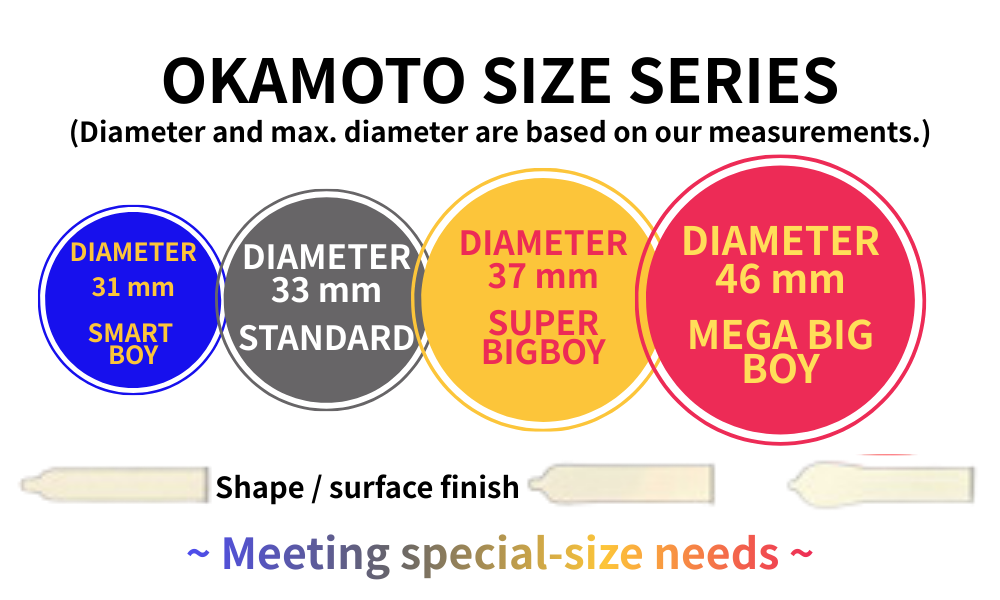
Okamoto uses diameter to group sizes. Here’s the simple breakdown:
- Smart Boy – 31 mm Snug / smaller size. Good if standard condoms always feel loose or slip.
- Standard – 33 mm “Normal” Japanese fit. Works for many people with average girth.
- Super Big Boy – 37 mm For thicker girth. Feels much easier to roll on if standard feels tight.
- Mega Big Boy – 46 mm Extra-large. For people who really struggle with tightness in regular condoms.
Tip: Japanese sizes often feel a bit snugger than Western brands in the same “size name”.
If regular US/EU condoms already feel tight, go up a size in Japanese brands.
2. How to find your size (without overthinking)
You only need one measurement: girth.
- Take a soft measuring tape or a strip of paper.
- Wrap it around the thickest part of your penis when fully hard.
- Mark it and measure the length in millimetres.
Then use this rough guide:
- Girth ~100–110 mm → try 31–33 mm (Smart / Standard)
- Girth ~110–120 mm → try 33–37 mm (Standard / Super Big Boy)
- Girth 120 mm+ → try 37–46 mm (Super / Mega Big Boy)
If you’re between sizes or unsure, start with two boxes in neighbouring sizes and see which one feels:
- easy to roll down
- snug but not squeezing
- not sliding off
3. Why Japanese condoms are worth trying
So why bother with Japanese brands at all?
3-1. Extremely consistent quality
Japan is famous for strict quality control. With major brands like Okamoto:
- every condom is electronically tested
- thickness and size are very consistent from box to box
- defects are extremely rare
That means less worry about “is this one OK?” and more focus on enjoying the moment.
3-2. Very thin, but not scary
Japanese makers compete on thinness – but they still have to meet strict safety standards.
You’ll see lines like:
- 0.01 mm or 0.02 mm polyurethane
- 003 (0.03 mm) latex series
They feel much closer to bare skin, but still give you the protection of a proper, tested condom.
3-3. Designs that focus on comfort and feel
Many Japanese condoms are designed to:
- warm up quickly to body temperature
- feel smooth or “bare” for your partner
- reduce the rubber smell
Some are slightly lubricated; others pair well with your favourite lube.
The goal is “it works, but I don’t have to think about it.”
4. Product picks you can actually start with
ここからアフィリンクを差し込むパートにする。
[Link → Shop A] みたいなダミーを入れておくから、あとで自分のアフィ URL に置き換える。
4-1. If you’re average size and want an easy first try
Okamoto 003 Standard (around 33 mm)
Clean, thin latex condom for people with average girth.
Why it’s good:
- famous “003” thinness – more feeling than regular Western condoms
- size fits many people; good as a first Japanese condom
- widely used, so reviews and info are easy to find
Use it when: you don’t know your exact size yet, but regular condoms usually fit fine.
Button placeholder: [Check Okamoto 003 on Shop A]
4-2. If regular condoms feel a bit tight
Okamoto Super Big Boy – 37 mm
If you ever think “I can get it on, but it feels tight and I lose sensation”, this is the one to try.
Why it’s good:
- more room in the shaft and tip
- easier to roll down fully without strangling feeling
- less chance of breaking from being overstretched
This is often the “oh wow, this actually feels comfortable” moment for people who’ve always used standard sizes.
Button placeholder: [Try Super Big Boy (large size) → Shop A]
4-3. If you really struggle with tightness
Okamoto Mega Big Boy – 46 mm
For people who:
- constantly break condoms
- can’t roll regular condoms down comfortably
- feel strong pressure at the base
Mega Big Boy gives much more room, especially at the shaft.
Why it’s worth trying:
- designed specifically for very thick girth
- reduces the “tourniquet” feeling at the base
- still made with the same quality and testing
Button placeholder: [View Mega Big Boy (extra-large) → Shop A]
4-4. If you’re on the slimmer side and hate condoms slipping
Okamoto Smart Boy – 31 mm
If standard condoms sometimes:
- slip during sex
- leave a lot of loose material at the tip
- feel like they’re “floating” instead of hugging
then a slimmer fit like Smart Boy can help.
Why it’s helpful:
- stays in place better on thinner girth
- can improve sensation because there’s less extra material
- especially good if you’ve always felt “between sizes”
Button placeholder: [See Smart Boy (slim fit) → Shop A]
4-5. If you’re curious about ultra-thin sensation
Pick a thinness level that still feels safe for you:
- Okamoto 0.02 – great starting point; noticeably thin but not too scary
- Okamoto 0.01 – for people who want the closest-to-bare feeling
Combine thinness with the right size from the chart above.
Fit is more important than chasing the thinnest number.
Button placeholder:
[Okamoto 0.02 (standard size) → Shop A]
[Okamoto 0.01 (premium ultra-thin) → Shop A]
5. How to read Japanese size labels
When you look at product pages, you’ll usually see:
- 直径 (chokkei) – diameter (for example 33 mm, 37 mm)
- 幅 (haba) – width (often about double the diameter in mm when flat)
- 長さ (naga-sa) – length (usually around 170–190 mm)
If you don’t understand the Japanese text, focus on:
- “標準サイズ / Standard” – average fit
- “大きめ / Large” or “BIG BOY” – for larger girth
- “小さめ / Small” or “SMART BOY” – slimmer fit
You can also save the OKAMOTO SIZE SERIES image to your phone and check:
“Is this condom closer to 31 mm, 33 mm, 37 mm or 46 mm?”
and match it to your girth.
6. Common worries (and honest answers)
“What if I choose the wrong size?”
- If it’s too tight: it feels hard to roll on, leaves a deep ring, or hurts → go one size up.
- If it’s too loose: it slides, bunches up, or feels like it might come off → go one size down.
It’s completely normal to test two or three sizes before finding your best one.
“Will thinner condoms break easier?”
With major Japanese brands, thinness doesn’t equal “cheap”.
They’re designed and tested to be safe at that thickness.
What really causes breakage is:
- wrong size (too tight)
- not enough lubrication
- using oil-based products with latex
“Can my partner feel the difference?”
Usually yes – and not just from thinness.
A condom that fits you well also moves more naturally, which feels better for both of you.
7. Simple starting plans
最後に「今すぐ何を買えばいいか」をはっきりさせるパートにする。
ここにそれぞれのボタンをまとめて置くと、クリックされやすい。
Plan A – “Average size, first time with Japanese condoms”
- Okamoto 003 Standard (33 mm) – 1 box
- Okamoto 0.02 (standard size) – 1 box
[Get Plan A on Shop A]
Plan B – “Standard feels tight, want more comfort”
- Okamoto Super Big Boy (37 mm) – 1 box
- One ultra-thin option in large size (for example, Big Boy version of 003 / 0.02)
[Get Plan B (for larger girth) → Shop A]
Plan C – “Very thick girth and tired of breakage”
- Okamoto Mega Big Boy (46 mm) – main condom
- Super Big Boy (37 mm) – backup size to compare
[Get Plan C (extra-large fit) → Shop A]
8. Final thoughts
You don’t need to memorise every Japanese brand or product code.
If you:
- measure your girth once
- match it to the Smart / Standard / Super Big Boy / Mega Big Boy size bands
- start with one or two boxes in the most likely size
…you’re already ahead of most people.
From there, you can decide:
- “I like this size, but want thinner.”
- “This thinness is perfect, but I need a little more room.”
and slowly build your own list of “always-works” Japanese condoms.